When we build systems, we often spend a surprising amount of time perfecting things that are nice to have, while overlooking where the real impact actually lives.
I’ve seen this pattern repeatedly in infrastructure work: polishing dashboards no one checks, over-engineering pipelines that already work, or debating tooling choices long after the decision stopped mattering. It feels productive — but it usually isn’t.
Launching this blog was a small, personal reminder of that same pattern.
At first, I focused on everything around the writing: the framework, the theme, the fonts, the colors, UI details, and the deployment setup. All of those things are worth getting right eventually, but none of them were the reason the blog existed in the first place.
The real point was simple: to write and share practical notes based on experience.
It took a conscious effort to stop tuning secondary details and move forward with something that was “good enough.” The moment the site went live, the perceived importance of many of those decisions dropped sharply. What remained was the only thing that actually mattered: having a place where writing could happen.
This trade-off shows up constantly in DevOps and platform work.
We often aim for perfection in areas that are easy to control, while delaying progress in areas that create real value. Infrastructure gives us endless opportunities to refine, optimize, and tweak — but not all improvements are equal.
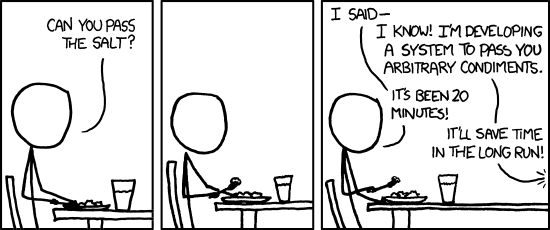
Once, I spent hours polishing dashboards — adding interactive charts, custom filters, and beautiful visualizations. What actually saved the day during a production incident, however, was a simple Slack alert I had set up in a few minutes. It caught the issue early and prevented escalation. The “perfect” dashboard looked impressive, but the basic alert delivered the real impact.
Another time, I was designing a self-service tool to help developers deploy AWS resources without needing to learn Terraform or manage credentials. I imagined everything the tool could eventually become: multi-environment deployments, security scans, dynamic scaling — you name it. It sounded great on paper.
What developers actually needed at that stage was much simpler: a straightforward way to deploy basic AWS resources like S3 buckets or RDS instances. In trying to build a future-proof, all-encompassing solution, I lost sight of the immediate problem. In reality, we just needed a way to deploy S3 buckets.
The difficult work is usually quieter:
- deciding what not to optimize yet
- accepting reversible decisions
- shipping something imperfect but usable
- creating space for the work that truly matters
This blog doesn’t exist because of a perfect setup. It exists because, at some point, the decision was made to stop preparing and start publishing.
That lesson applies far beyond blogs.
Most of the time, impact doesn’t come from perfect systems — it comes from deciding where to stop optimizing and move forward.