CI means integrating small changes frequently and automatically checking that they work together. CD can mean continuous delivery: keeping software ready to deploy; or continuous deployment: automatically sending every change that passes the defined checks to production.
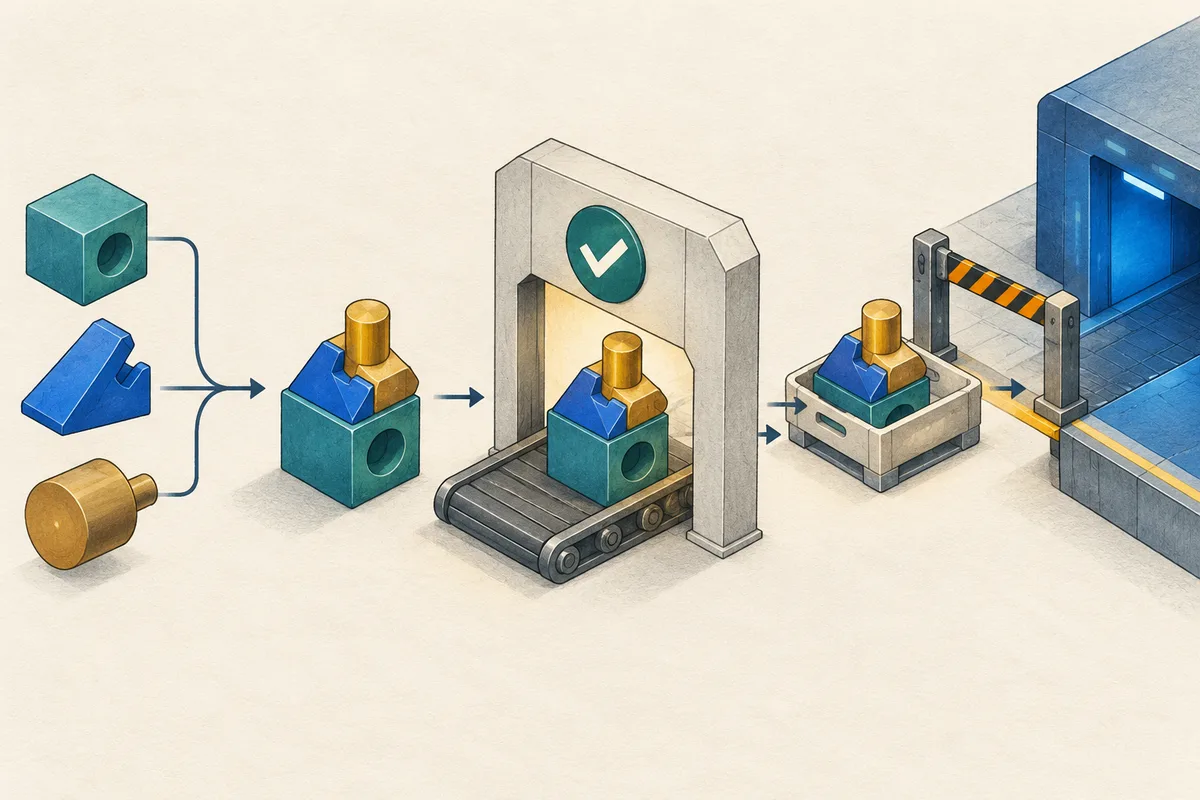
The change joins the shared code, is verified, and is prepared for production. The same tested artifact is used for deployment.
What do the checks actually do?
A build prepares source code for execution or distribution, for example by compiling it or packaging an image. An automated test compares actual behavior with an expected result. A unit test checks a small piece in isolation; an integration test checks cooperating parts, such as the application and a test database.
A pipeline is an ordered set of automated tasks. For the checkout fix, it might build an image, test the total calculation, and check that a test order can be saved. Failed checks should stop that version from advancing until the team understands and fixes the failure. Passing checks provide evidence, not proof that every real purchase will work.
Continuous integration
Continuous integration depends on bringing changes into shared code frequently and repairing broken integrations promptly. Running tests on a branch that stays isolated for a month does not prevent surprises when it is finally merged.
Builds and automated tests provide feedback on the combined code. GitHub Actions and similar tools can run those tasks, but adopting a tool alone does not change how a team integrates its work.
Continuous delivery and deployment
With continuous delivery, a verified version is ready to deploy whenever the team chooses. A human approval before production is compatible with continuous delivery.
With continuous deployment, every change that passes the defined checks reaches production automatically. There is no manual approval for each change. The team needs effective checks, observability, and a recovery path if actual behavior fails.
The artifact deployed to production
An artifact is an identifiable software version, such as a container image. Promoting the same artifact through tests and environments helps ensure that production receives what was verified, rather than a different version rebuilt for deployment.
Deployment should be repeatable, and its result should be observed in production. Tests reduce uncertainty, but they cannot guarantee coverage of every real condition.
After deployment, observe error rates, response times, and completed orders. Observability means having signals, such as metrics and logs, that help explain how the running system behaves. Decide who will stop a failing release and how to recover before exposing users to it.